
 GET A QUOTE

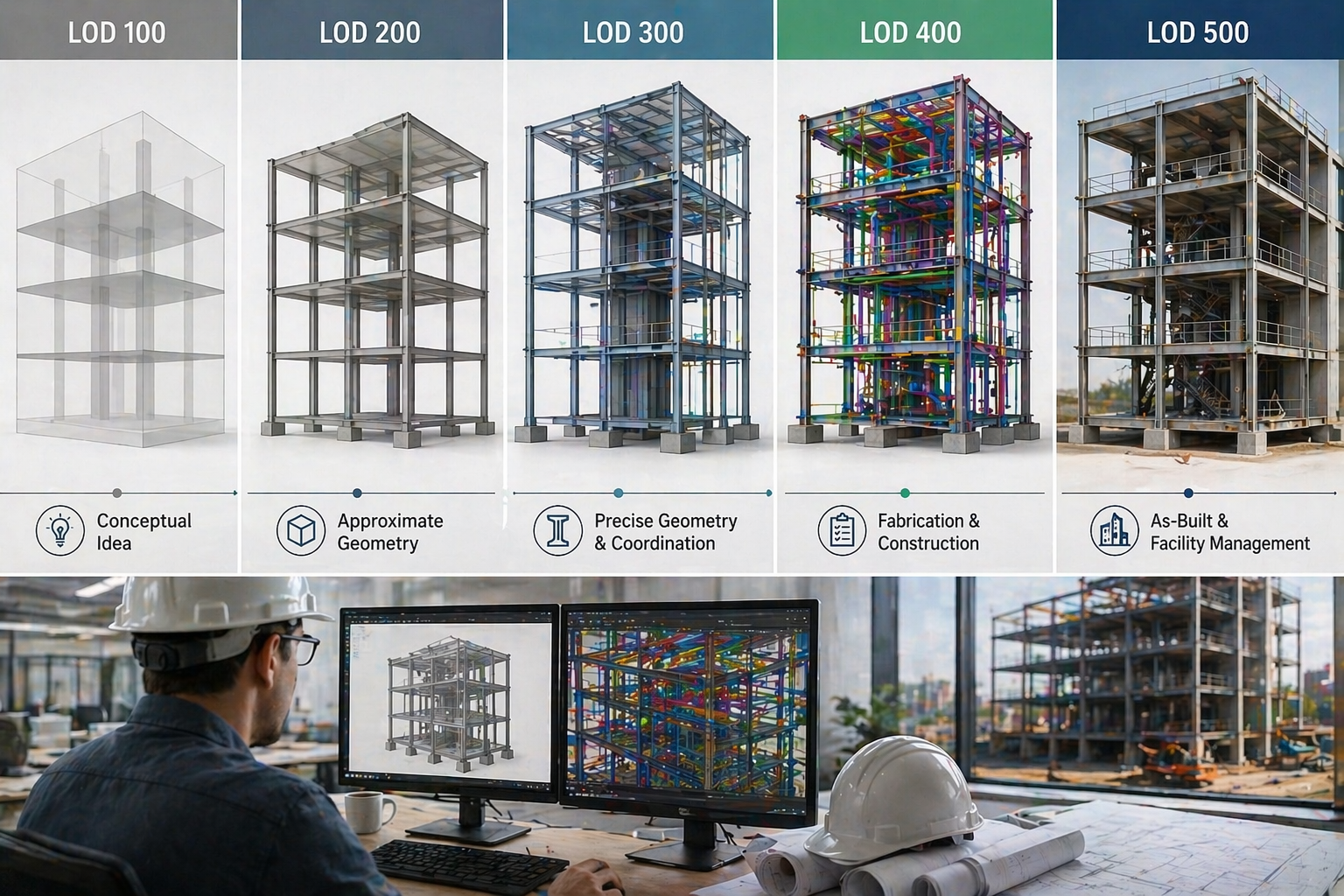
Level of Detail  or Level of Development  is one of the most important and frequently misunderstood concepts in BIM project management. It defines how geometrically precise, information-rich, and reliable a model element is at a given stage of the project. Getting LOD requirements right at the start of a project ensures that the BIM investment delivers coordination and construction value  rather than producing a model that looks detailed but cannot actually be used for the purpose it was intended.
This article explains the BIM LOD scale from 100 to 500, with a focus on how each level applies to structural steel and concrete elements in construction projects.
At LOD 100, structural elements are represented as conceptual masses or generic symbols. There is enough information to understand overall building form and approximate gross floor areas, but individual structural members are not modelled with accurate geometry. This level is used for early feasibility studies, master planning, and concept design. Structural quantities and material specifications at this stage are indicative only.
At LOD 200, structural elements are modelled with approximate size, shape, location, and orientation. A steel column may be represented as a generic I-section of roughly correct proportions, but the exact profile, grade, and length have not been confirmed. This level supports preliminary design coordination and early cost planning. Clash detection at LOD 200 catches major spatial conflicts but cannot identify fine-grained coordination issues.
--- VHS Engineering Team"Specifying the right LOD for each project stage is what separates a useful BIM model from a detailed 3D picture that no one can build from."
LOD 300 is the standard for coordinated design and construction documentation. Structural elements are modelled with accurate dimensions, profiles, grades, and locations. Connections are represented with sufficient detail for coordination with architectural and MEP disciplines. At this level, the model can support reliable clash detection, quantity take-offs, and construction planning. Most structural coordination reviews operate at LOD 300 or LOD 350.
LOD 350 extends LOD 300 by including interface elements  connection plates, embedments, hangers  that are needed for coordination with adjacent trades. It is the minimum level at which meaningful structural-to-MEP coordination can occur.
At LOD 400, the structural model contains sufficient detail for direct use in fabrication. Steel members are modelled with exact profiles, lengths, hole patterns, weld preparations, and finish specifications. Connection details are fully resolved at the component level. The model at LOD 400 can be used to generate shop drawings directly, produce accurate MTOs for procurement, and drive CNC fabrication equipment in modern steel workshops.
VHS Engineering produces LOD 400 structural models using Tekla Structures, enabling direct integration between the design model and the fabrication process  reducing error, shortening delivery timelines, and improving quality traceability.
LOD 500 represents the as-built condition of the completed structure  the model as it was actually constructed, including any field modifications, substitutions, or dimensional deviations from the design intent. LOD 500 models are used for facilities management, maintenance planning, and future renovation or extension projects. They are typically produced by updating the construction model with as-built survey data at project completion.
Not every project needs a LOD 400 model, and not every element needs to be at the same LOD throughout the design process. A BIM Execution Plan (BEP) should specify the required LOD for each element category at each project phase, matched to the actual deliverables and uses of the model. Specifying LOD requirements that exceed what the project actually needs wastes modelling effort; specifying too low prevents the model from delivering its intended coordination or construction value.