
 GET A QUOTE

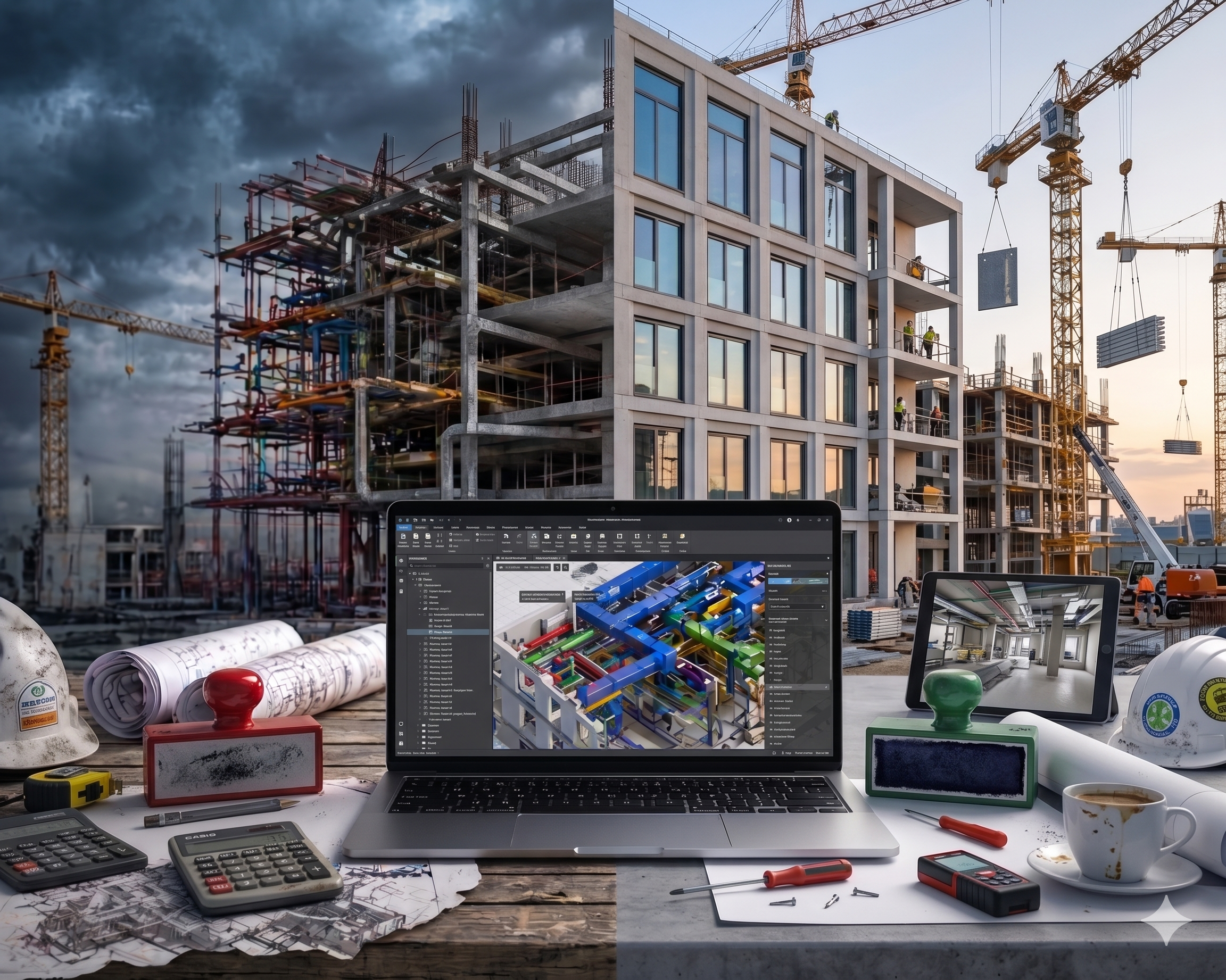
Building Information Modelling (BIM) has fundamentally changed how multi-discipline construction projects are planned and delivered. Beyond producing 3D models, BIM enables real-time coordination between structural, architectural, and MEP (mechanical, electrical, plumbing) teams  catching conflicts before they become on-site problems.
For engineering firms and contractors managing complex projects, BIM coordination is no longer optional. It is one of the most effective tools available for protecting project schedules and controlling costs.
BIM coordination is the process of combining discipline-specific models into a federated model, then reviewing the combined model to identify and resolve geometric clashes, construction sequencing issues, and design inconsistencies. It replaces the traditional 2D drawing overlay process with a dynamic, data-rich environment where every conflict is visible and traceable.
Clashes are typically categorised as hard clashes (physical overlaps, such as a structural beam penetrating a duct), soft clashes (clearance violations), and workflow or sequencing clashes. Each type has different implications for construction, and all are better resolved in the model than on the job site.
--- VHS Engineering Team"Every clash resolved in the model is a delay avoided on site. BIM coordination protects schedules and client relationships."
Rework is one of the largest hidden costs in construction. When a clash is discovered during installation  for example, when a structural connection point conflicts with a mechanical service line  work must stop, parties must be consulted, redesign must occur, and previously completed work may need to be undone. The cost is not just materials; it is programme time and contractor relationships.
BIM coordination, when structured early in the design and pre-construction phase, surfaces these conflicts while changes are still inexpensive. A revised connection detail in a model takes hours. The same revision on a fabricated and delivered steel member takes days, incurs fabrication costs, and may delay the erection programme.
At VHS Engineering, BIM coordination is integrated into our structural design and detailing workflow. We produce federated models that can be used for discipline coordination, construction planning, and client review. Our team works with Revit, Tekla Structures, and Navisworks to deliver clash reports, model updates, and issue logs that drive efficient project communication.
Our coordination services cover structural-to-architectural alignment, structural-to-MEP clash resolution, hold point and access coordination, and model-based quantity take-offs to support procurement.
The value of BIM coordination depends on the Level of Detail (LOD) of the models being reviewed. At LOD 300–350, structural models carry sufficient geometric and connection information to support meaningful coordination with other disciplines. At LOD 400, models are fabrication-ready and can directly inform shop drawing production and material ordering.
VHS Engineering works with clients to define appropriate LOD requirements at project outset, ensuring that the modelling investment delivers coordination value proportionate to project complexity.